

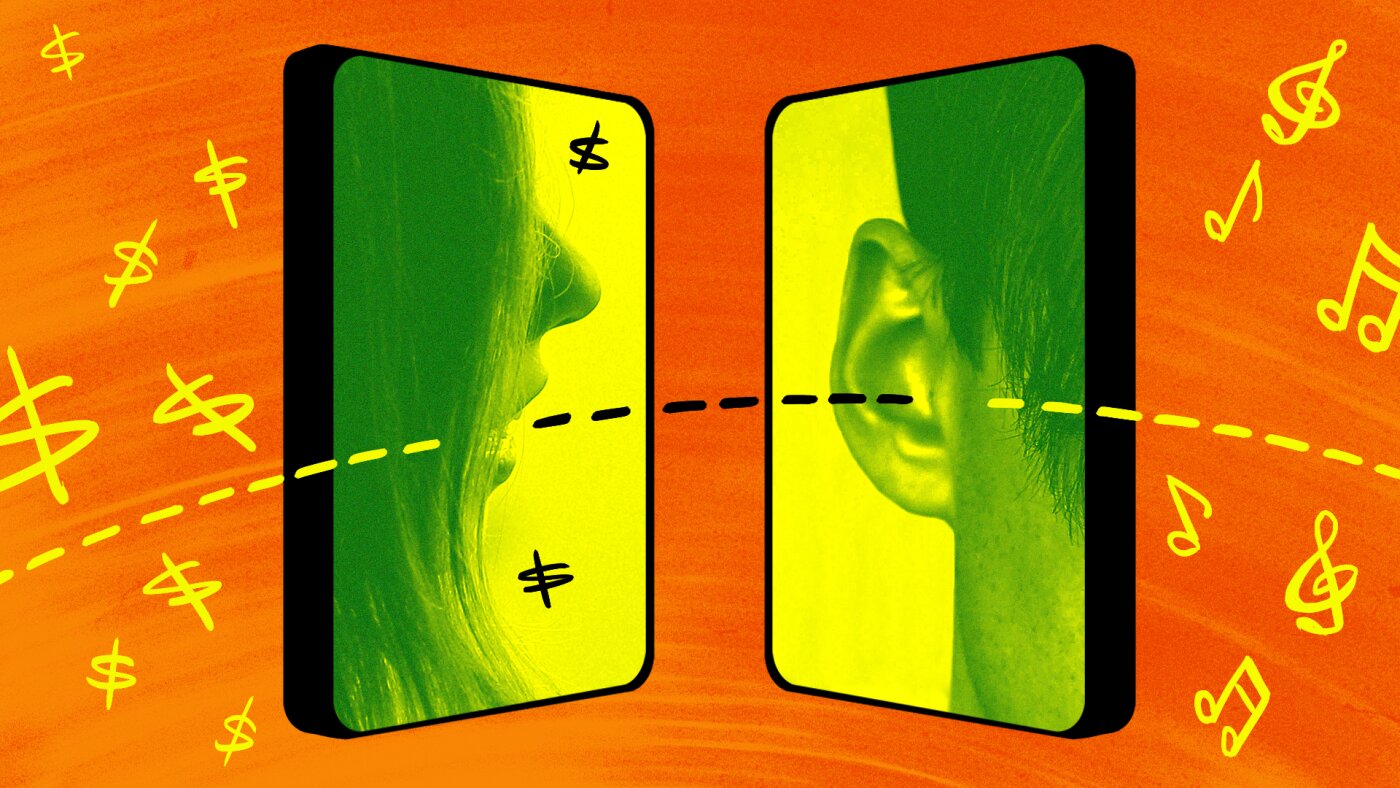

Although some influencers largely appear to be common individuals sharing their love of music, the content material they’re making can generally be a type of hidden promoting.
Illustration for NPR by Jackie Lay
cover caption
toggle caption
Illustration for NPR by Jackie Lay
The panorama for music discovery has modified drastically over the previous couple of a long time. Largely gone are the times of discovering your new favourite music by watching MTV or switching via radio stations. Journal and newspaper evaluations are tougher and tougher to return by, given the decline of print journalism (and humanities protection particularly). And as of late, your common music fan may discover a new album or artist just by scrolling social media, inundated with memes, dance challenges and opinionated influencers.
Platforms like TikTok and Instagram have change into large drivers of success within the music business. TikTok is now key to breaking artists into the zeitgeist (see: this 12 months’s greatest new artist nominees on the Grammys) and serving to songs — both new or outdated — climb Billboard’s Sizzling 100 chart. On these apps, music influencers have change into the modern-day equal of radio hosts or VJs. They’re typically impartial content material creators reasonably than staff of a media conglomerate; they construct their audiences via short-form movies that rely extra on the whims of the algorithm than conventional gatekeepers of the business. Their content material is pushed by their private preferences and judgments, forming a brand new type of media persona for music followers to latch on to: a trusted voice to let what’s taking place in music.


However although influencers largely appear to be common individuals sharing their love of music, the content material they’re making can generally be a type of hidden promoting. NPR spoke with 5 music influencers who say they typically settle for funds to submit about sure songs or artists with out disclosing sponsorship. Some say they do not see any points with this technique — behind-the-scenes funds from labels or companies for music promos — whereas others say they really feel conflicted in regards to the funds and do not need to be seen as “promoting out” to the business.
Carly Bogie, who posts on TikTok as @hahakcoolgtgbye to over 80,000 followers, began posting “cool lady playlist” movies almost seven years in the past, principally geared in the direction of gathering her favourite indie rock and pop songs. As her following grew, the previous chemical engineer says she started getting approached by labels and artists to characteristic particular songs on her web page. Bogie says she “felt hesitant” about accepting funds at first, however later began working with a supervisor who helped her work out which charges to cost for various sorts of content material, whether or not it’s undisclosed music promos or sponsored posts which can be explicitly labeled as ads for ticketing corporations or headphone manufacturers.
“He was very useful to be like, ‘That is your price. What you are doing is a really influential a part of the music business proper now,'” Bogie says. “‘You should be paid for a number of the issues that you simply’re doing.'”
A few of the music content material she posts — like artist interviews, which she says she’s been spending extra time on — are unpaid. On the subject of music and artist promos, Bogie says her fee per video ranges from $150 to $400 per submit, relying on the scope of the marketing campaign. Lately, Bogie says she was paid $400 every for 2 movies a few main label pop star coming off the success of a Billboard Sizzling 100 entry. When requested who approached her on behalf of the artist for these particular promos, Bogie says her supervisor dealt with all communications.
“The one stuff that I promote is stuff that I actually get pleasure from and would submit about anyway,” Bogie says. “I really feel like that may be a very tough state of affairs as a result of I by no means need my viewers to suppose that I am simply posting stuff to receives a commission for it.”
To reveal or to not disclose?
NPR spoke with a TikTok influencer from California with 1.1 million followers who requested anonymity so he may converse freely in regards to the relationship between creators and music labels. He says he started posting TikToks through the pandemic, initially sharing his personal unique music earlier than pivoting into suggestion and curation content material. As his following grew, he says he additionally labored as a contractor for a label, serving to artists launch their very own TikTok accounts or creating “burner accounts” — unofficial accounts used to edit and add clips of archival interviews, music movies and different footage in an effort to fill social media feeds and make an artist go viral on the app.
“It is similar to the collective consciousness — what is the lengthy tail of placing all this content material on the market for each single artist on the web?” he says, relating to the aim of those burner accounts. “Then if one factor pops, what might be the results of that? We simply need to have this social digital forex and be high of thoughts.”
After a number of years creating label expertise, the California TikTok influencer now works as a full-time content material creator. His music promo charges, he says, are on a sliding scale from roughly $300 to $600 per video; he says he avoids charging flat charges for smaller artists with a view to assist indie acts enhance their visibility. Based mostly on his work and expertise in each the content material and music business, he says undisclosed music promos are sometimes handled like an open secret.
“Technically, you’re speculated to disclose it legally, nevertheless it’s type of understood that you do not ever put #advert [in the caption] or disclose all of it when it is a paid promo. That is been par for the course the whole time I have been doing these promos,” he says, including that document labels or advertising and marketing companies will typically explicitly ask creators to not disclose cost. “I speak to quite a lot of creators and nobody discloses it. It is type of understood that in the event you do disclose it, it will harm the efficiency of the content material.”


Advertisements have change into more and more prevalent on social media platforms over the past decade, a lot so that individuals generally exit of their option to make clear when no matter they’re about to advocate is not paid advertising and marketing. Influencing, in consequence, has change into a full-on profession. Many creators companion with manufacturers to brazenly promote merchandise like make-up or clothes with out backlash, however latest occasions within the music business have revealed that followers can reply negatively after they study that content material about sure songs or artists is being sponsored.
Digital advertising and marketing sparks backlash
In March, the co-founders of the digital advertising and marketing company Chaotic Good Initiatives spoke to Billboard throughout a stay podcast taping at SXSW music pageant about one in all their many methods for manufacturing virality: creating faux fan accounts to submit, remark and share clips for the artists on their roster, which ranged from indie rock teams to main pop stars. The admission sparked outrage from followers, most of it aimed on the Brooklyn band Geese. Chaotic Good Initiatives didn’t reply to NPR’s request for remark. Though digital advertising and marketing isn’t new, Chaotic Good’s admission proved to a technology of music followers who’ve grown up utilizing social media that on-line narratives are simply manipulated.
A part of the enchantment of on-line music curation is how natural it feels: any music fan can document themselves speaking about what’s on their playlist and why it ought to be on yours, too. Private style is meant to be the precedence. However as TikTok and Instagram have grown inundated with sponsored posts, some followers suspect that on-line music stardom is being extremely engineered behind the scenes. Open the remark sections for many rising pop stars and the phrases “business plant” and “nepo child” are certain to make an look — the accusation that anybody who seems to be experiencing in a single day success have to be the product of a carefully-executed label marketing campaign, business connections or some mixture of the 2.
Nevertheless it’s not simply followers who’ve criticized on-line advertising and marketing techniques. In June, British singer and producer James Blake posted a collection of complaints on his Instagram tales, saying that album evaluations, remark sections and streaming numbers are more and more being inflated or exploited for revenue.
“In case you’re an artist, do not forget that in 2026 there’s not a single a part of the system that is not faked,” Blake wrote.
NPR reached out to a number of document labels — together with Interscope, Republic, Atlantic, RCA, Arista, Epic, Columbia, Sub Pop and the final inboxes for Sony, Common Music Group and Warner Music Group — to ask whether or not they have interaction in influencer advertising and marketing campaigns and if that’s the case, whether or not they advise content material creators to reveal paid partnerships. On the time of publication, not one of the labels have responded to NPR’s requests.
Guidelines for influencers
However there are nonetheless guidelines influencers are speculated to observe. The Federal Commerce Fee’s pointers for social media influencers state that creators should clearly and brazenly inform their viewers if they’ve any “monetary, employment, private, or household relationship with a model” that they are posting about. In keeping with the FTC, if the endorsement is a part of a video, creators ought to disclose it not solely within the caption, but in addition as superimposed textual content on the video itself and within the audio to be as clear as attainable. When requested whether or not undisclosed music promos violate these pointers, the FTC informed NPR that it takes “every state of affairs on a case-by-case foundation and may’t touch upon particular conditions like this.”
Bryson Keith, an influencer with 1 million followers on TikTok, says these pointers really feel much less clear in terms of selling a music versus a bodily product. He estimates that he makes the vast majority of his earnings from disclosed model offers with corporations that promote ear plugs or drinks, and that lower than 10% comes from undisclosed music promos.
“They [labels or agencies] normally inform you when it must be disclosed and labeled as an advert,” he says. “However I do not know, I assume it is just a little bit completely different with music as a result of nobody’s actually shopping for something. You are simply listening to a free music.”
In actuality, some type of pay-to-play mechanism has existed within the music business for a whole bunch of years, going again to when musicians would receives a commission to advertise sheet music within the nineteenth century. As radio grew to become a dominant type of leisure within the 1900s, labels began paying disc-jockeys to play sure songs on air with out disclosing cost. In 1960, the Federal Communications Fee made amendments to prior sponsorship legal guidelines that successfully outlawed payola in broadcasting, although investigations and settlements associated to the apply continued properly into the twenty first century. Social media platforms, nonetheless, do not fall underneath the FCC’s jurisdiction.
All the creators NPR spoke with described the same pipeline for music promos. A label or company reaches out to the creator or their supervisor, asking for his or her fee for a selected type of video. A number of influencers mentioned it’s normal apply for labels to request a “fee card” to have on file, which breaks down a creator’s charges for posting on TikTok, on Instagram feed, Instagram tales or a mixture of the choices. If the creator accepts a promo, they create a draft of the video to be despatched to the label or company for approval. As soon as all events have signed off, the video goes up and the creator will get paid. All the influencers NPR spoke with mentioned they settle for cost for songs that they’d already be more likely to promote.
“I believe we’ve got a duty to our viewers to remain true to our style as a result of then they belief us, and so they belief that we’re sharing music that we love,” Keith says. “I believe when you begin taking stuff out of comfort, it exhibits on the content material.”
A quickly altering business
The California TikTok influencer says that inside the music content material creation subject, these paid music and artist campaigns look completely different as we speak than they did three or 4 years in the past. He says he is seen a major shift within the genres that labels are paying to advertise — whereas a number of years in the past there was extra money in hip-hop, he says he is now seeing extra campaigns geared in the direction of nation and various rock.
“It is actually wild to see the place the cash goes is the place the ears go,” he says. “Though labels cannot essentially pressure an artist on you or pressure a style on you, they will actually do quite a lot of harm for good or for unhealthy with the place their budgets are being positioned.”
He additionally says he is seeing extra funding in cost-per-mille campaigns reasonably than creator-first promoting. This implies a label or company will announce a marketing campaign round a music or artist, and social media customers will submit movies — typically edited clips of present content material (music movies or archival interview footage) reasonably than newly-scripted promos created by influencers — that earn cash primarily based on what number of views they obtain (ex: $2 per thousand views collected on every clip).
“Now every little thing is tied to the efficiency of a video,” he says. “It is truthful, however these vertical platforms, particularly TikTok, the views are so risky, it is exhausting to cost your self as a creator as a result of one video may do 5,000 views and flop, or a video can do one million views and create a lot worth for for the artist or the label or the marketing campaign.”
For content material creators who don’t settle for cost in change for protection, this rapidly-evolving panorama highlights greater systemic points. Anthony Fantano is a distinguished music influencer who began posting album evaluations on YouTube greater than a decade in the past. His content material largely paved the way in which for the type of short-form criticism and curation that dominates social media as we speak (his platform, The Needle Drop, originated as a podcast and radio present on Connecticut Public Radio). Fantano has a background in music journalism and says he doesn’t settle for any type of financial incentive to assessment or cowl music, although that hasn’t stopped labels from approaching him with presents.
“Lots of these developments are all being mirrored by only a widespread desperation that we’re seeing within the music business, within the financial system — desperation for cash, desperation for consideration, as a result of it is all troublesome to return by,” he says. “It is tougher to receives a commission. It is exhausting to get individuals to concentrate to something persistently.”
Fantano says the web’s early promise of decentralized and democratized data has largely been changed by polarizing content material that makes nuanced discourse about something — music, politics, social points — more and more scarce. As inflation rises and the job market slows, social media monetization will be an accessible option to make cash. However a scarcity of transparency about what’s sponsored and what’s not, significantly within the music house, ought to give social media customers pause, he says.
“I believe web customers want to start out these platforms that they are getting serviced content material on just a little bit extra skeptically. Geese did not cheat the algorithm. The algorithm is a cheat already,” Fantano says, in reference to the Chaotic Good marketing campaign. “The algorithm is a manipulated, man-made factor that exists purely for the revenue motives of the corporate that it was developed by.”
Like Fantano, Australian influencer Derrick Gee, identified for his music discovery and commentary movies, says he personally opposes accepting funds. His web site contains an “ethics and transparency” part the place he outlines that he doesn’t have interaction in any type of paid advertising and marketing campaigns for labels, artists, administration and publishing corporations with a view to uphold belief along with his viewers. He says that though this TikTok period of pay-per-play is simply the mutation of a long-existing apply within the business, he believes short-form video establishes a regarding new precedent.
“The issue with it now’s that it is like Common Joe from Denver begins with a ardour for music and in a 12 months is pushing slop as a result of somebody paid him to,” Gee says. “I do not suppose that is probably the most ethical factor for that particular person or ethical factor for the business to buy individuals’s faces to be the promoter [of a song.]”
Discover un-influenced (as at all times) suggestions for the most effective songs and albums of the primary half of 2026 from NPR Music’s hosts and critics. And keep up-to-date by subscribing to our weekly e-newsletter right here.