

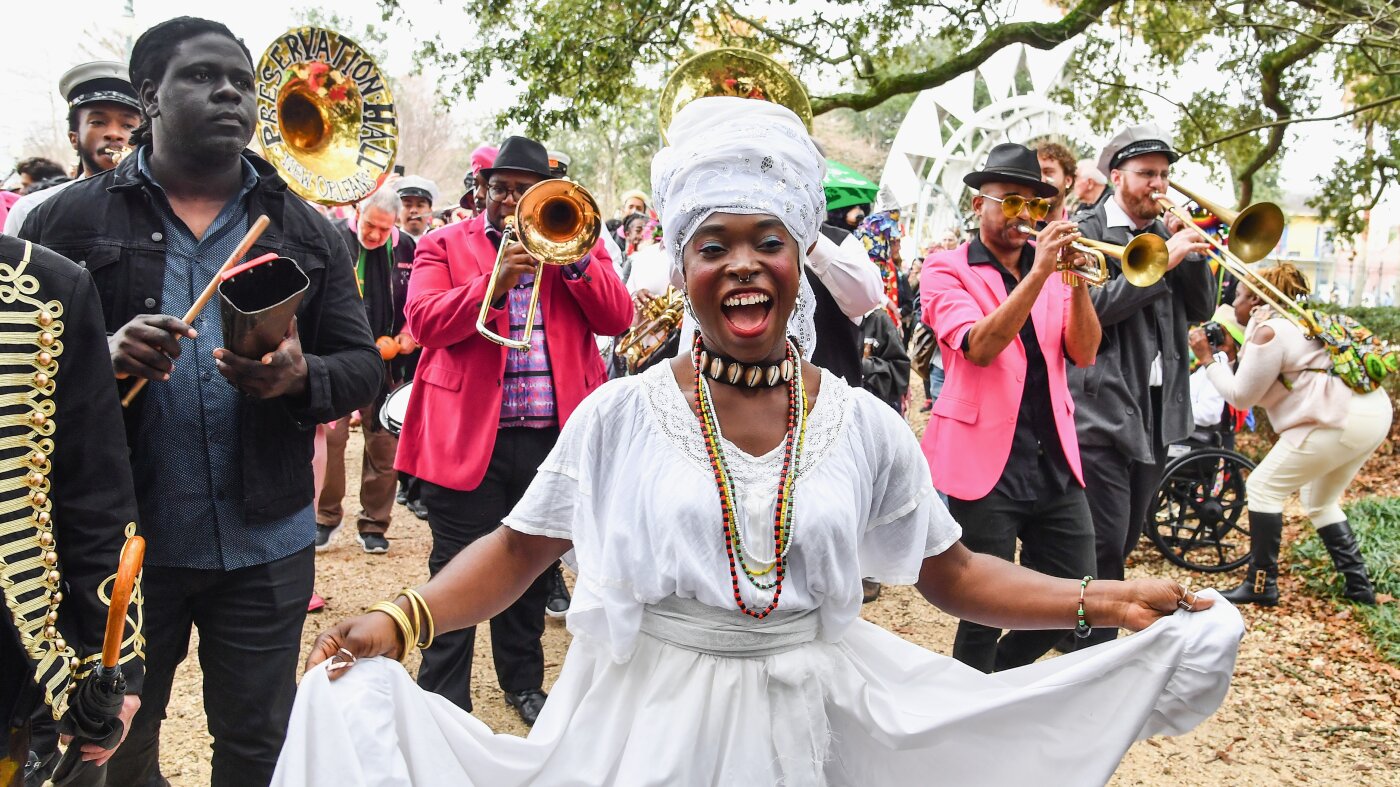

The group Krewe du Kanaval celebrates Mardi Gras season in New Orleans’ Congo Sq. in Feb. 2018.
Erika Goldring/Getty Photographs
conceal caption
toggle caption
Erika Goldring/Getty Photographs
Congo Sq. remains to be a wealthy place to listen to music. Yearly, Mardi Gras Indians stage pleasant musical battles beneath its dwell oak bushes.
“Congo Sq. is floor zero of what I’d contemplate the massive bang of American music tradition,” mentioned musician and eight-time Grammy Award winner Jon Batiste, who — alongside together with his many accomplishments as a marquee artist — is a part of a multi-generational household of greater than two dozen New Orleans musicians.

Batiste mentioned that Congo Sq. gave the U.S. its foundational inventive parts: ritual, rhythm, track and dance that “exist within the very cloth of this nation, interwoven into the whole lot that we do. They’re ubiquitous in a method that’s just like the air that we breathe.”
Congo Sq. is within Louis Armstrong Park, simply inside the Treme neighborhood of New Orleans. This Could, the temperature is already blistering. Regardless of the warmth, the park is dotted with vacationers and tour guides chatting amidst the clangor of close by renovation on the town’s Municipal Auditorium – which was devastated greater than 20 years in the past throughout Hurricane Katrina and has languished, empty, ever since.
Scholar Freddi Williams Evans has written two books on Congo Sq.. “Congo Sq. is on the opposite aspect of Rampart Avenue,” she noticed, “that means the tip of the official city. So it developed as a spot for unofficial occasions like cockfights, ball video games and political rallies. Finally, it turned referred to as the place the place enslaved Africans have been capable of collect on Sunday afternoons. It is not the one place they gathered, and never constantly, nevertheless it’s the place for which now we have the most effective documentation. There was by no means a legislation saying that they’d the proper to collect, so they only actually seized the chance.”

Evans mentioned that in cities colonized by Protestant Europeans, together with the Dutch and the British, Sundays have been quiet days for pious non secular habits. However as a result of New Orleans was initially beneath French rule, the vibe within the metropolis on Sundays was totally different. “After the hours of mass, Sunday afternoons have been for recreation and enjoyable,” she mentioned. “By legislation, Sundays have been to be work-free for all inhabitants of the French colonies, and by default that included the enslaved individuals.”
She mentioned that such gatherings have been allowed, on and off, however not constantly — and in 1817, a metropolis code restricted gatherings of enslaved Black individuals to at least one place: Congo Sq.. There, they gathered for non secular rituals, and for singing, dancing and drumming (which in numerous African traditions, typically consists of these parts).

An indication at New Orleans’ Congo Sq. commemorating the location’s historic significance, captured shortly after the marker was posted in 2008.
Invoice Haber/AP
conceal caption
toggle caption
Invoice Haber/AP
One of many drums they used, the bamboula, and a rhythm carefully related to it — counted as 3 + 3 + 2 — turned a part of a shared vocabulary between Africa, the Caribbean and the port metropolis of New Orleans.
“In Cuba,” Evans mentioned, “the rhythm acquired the title tresillo. In Haiti, it could be known as one thing else. There are such a lot of names for it, and that’s the foundation of Mardi Gras Indian music — the second line beat, the parade beat, the bamboula beat.”
It is endured over many generations — and, like all rhythms, will not be essentially performed on a drum: New Orleans native, the pianist and composer Jelly Roll Morton, is taking part in it together with his left hand in a 1923 recording of his “New Orleans Joys” (also called “New Orleans Blues”). You can even hear that rhythm propelling this up to date track, “Do Watcha Wanna” by the New Orleans group Rebirth Brass Band, through which it is performed by low brass.
That bamboula rhythm, deep on the bass, is the signature sound of a New Orleans second line, handed from technology to technology. However it’s a lifestyle as nicely, Jon Batiste mentioned.
“New Orleans is especially distinctive in that now we have this lineage of musicians whose households nonetheless exist and are carrying the traditions ahead,” Batiste mentioned.

Not solely that: everybody inside New Orleans musical households have a particular function to play within the hierarchy — identical to in West African griot households, whose members are musicians, storytellers, poets, and the oral historians of their communities.
“The best way it is handed down is similar as it’s in African cultural traditions, West Africa, within the Congo and Benin, with the Yoruba individuals, the Igbo individuals,” Batiste mentioned. “It is griot, it is an oral custom. It is a method of figuring out very early on, who’s the drummer? Who’s the elder going to mentor to fill this place inside our tribe?”
“A variety of occasions,” Batiste continued, “somebody is recognized very early of their life within the household. ‘Oh, that is the brand new chief,’ or ‘That is the one who’s going to be our arranger. That is the one who’s going to be our orchestrator. That is the one who’s going to proceed to construct the enterprise and the infrastructure round it.’ As a result of villages all have this type of hierarchy of authority, and totally different points of it must be led by totally different individuals. And also you begin to perceive that in musical households in New Orleans that there is a actual tribal understanding that’s rooted in the way in which that we dwell and go on the traditions. And as a kind of tradition bearers, I discover that it is an unbelievable pleasure and an excellent accountability, and an excellent strain.”

Tonya Boyd-Cannon is a New Orleans-based singer. She says she feels that weight too, as a artistic descendent of these individuals who gathered in Congo Sq..
“I’m chargeable for selecting up what my ancestors put down,” Boyd-Cannon mentioned. “So in the event that they laid the inspiration, I want to select it up and be daring with it. On Sundays, they nonetheless gathered at Congo Sq., the place freedom was solely on someday, and solely till sunset, it might be remiss to not share that with these children who’re developing and already talking the languages.
Boyd-Cannon is a member of the present cohort of the just lately established Jazz Generations Initiative, co-founded by the famous composer and pianist Courtney Bryan. Amongst its big selection of actions in New Orleans and New York, this system brings collectively cross-generational musicians and audiences to nurture and maintain this American-born fashion.
“One of many issues I used to be actually enthusiastic about was to have a gathering of musicians who’re doing actually artistic work in and outdoors of the town, however very rooted in New Orleans,” Bryan mentioned. The initiative, she mentioned, is creating revolving cohorts of artists the place “everyone comes collectively to share concepts creatively and business-wise, to provide occasions which can be intergenerational and interdisciplinary as nicely.”
That is a vital a part of the Congo Sq. legacy: to carry onto elders’ tales and traditions, to be artistic at this time it doesn’t matter what, and to go that heritage ahead.
