

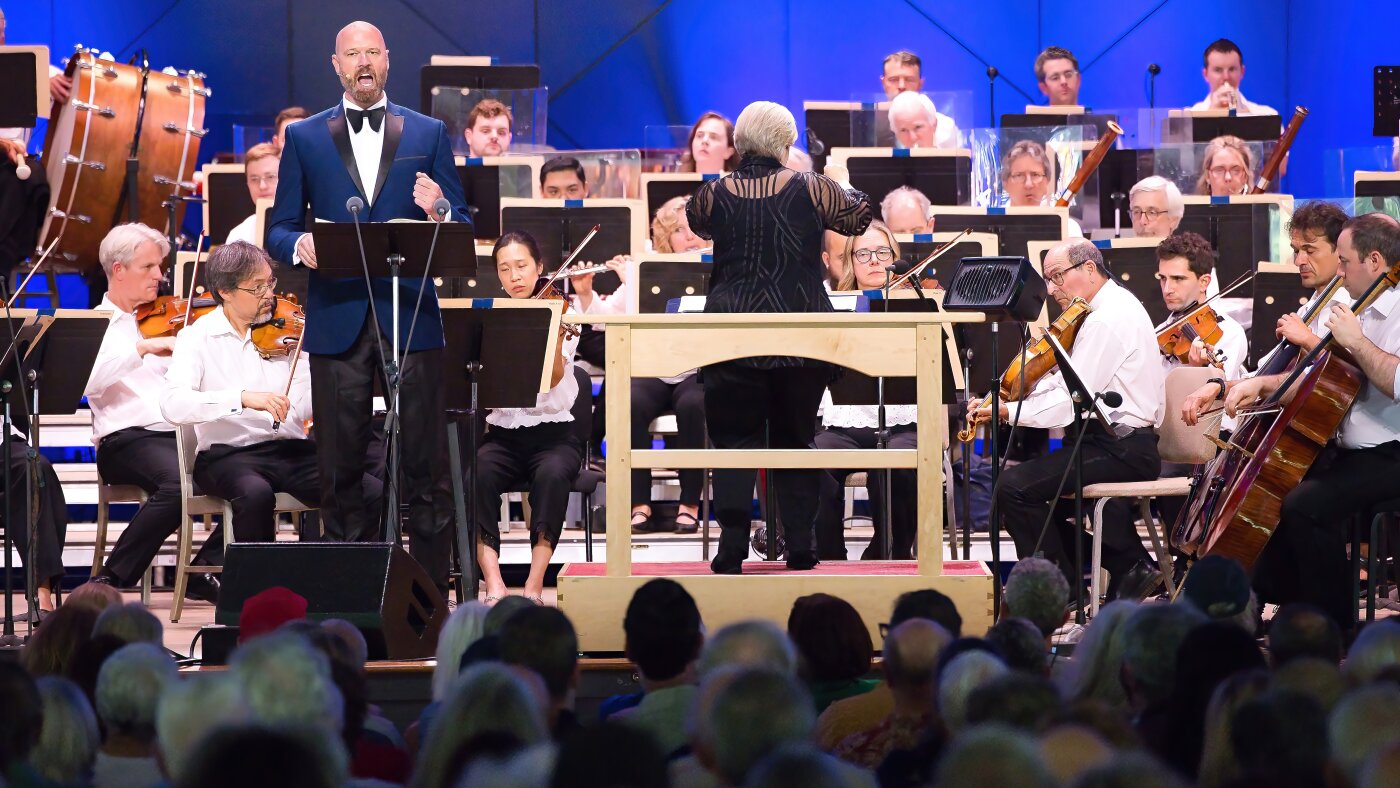

Baritone Zachary James and the Boston Symphony Orchestra, led by conductor Karen Kamensek, carry out Philip Glass’ Symphony No. 15 ‘Lincoln’ at Tanglewood in Lenox, Mass. on July 5, 2026.
Hilary Scott/Courtesy of the Boston Symphony Orchestra
cover caption
toggle caption
Hilary Scott/Courtesy of the Boston Symphony Orchestra
As soon as upon a time, it appeared like a pure match for composer Philip Glass to have his newest symphony premiered on the Kennedy Middle, through the nation’s 250th anniversary 12 months. The work honors Abraham Lincoln; Glass is a revered American composer who was awarded the Nationwide Medal of Arts in 2015.
However issues did not go fairly that manner. As a substitute, the piece had its world debut Sunday with the Boston Symphony Orchestra.
Abraham Lincoln has appeared as a personality in a number of of Philip Glass’ works already, together with the stage work The Civil Wars and within the opera Appomattox. An animatronic Lincoln — not not like the one within the Corridor of Presidents at Walt Disney World — even seems in Glass’ opera The Excellent American, about Walt Disney; Disney has a duet with the machine model of Lincoln.
This time round, Glass wished to focus solely on Lincoln, utilizing Lincoln’s personal phrases.

The work was set to premiere with the Nationwide Symphony Orchestra final month. However recently, nothing has been routine on the Kennedy Middle, the place till just lately President Trump’s title appeared on the constructing, and the place Trump has been chairman since early 2025. Glass felt the humanities complicated had been politicized. In January, he withdrew the work, writing on social media: “Symphony No. 15 is a portrait of Abraham Lincoln, and the values of the Kennedy Middle at the moment are in direct battle with the message of the Symphony. Subsequently, I really feel an obligation to withdraw this Symphony premiere from the Kennedy Middle underneath its present management.”
So as a substitute, the Boston Symphony Orchestra carried out it at Tanglewood, its summer time house within the Berkshire Mountains of Massachusetts, pairing it with a collection of John Williams’ music for the Steven Spielberg movie Lincoln, in addition to a efficiency of Aaron Copland’s “Lincoln Portrait” narrated by actor Alec Baldwin.

Composer Philip Glass.
Rebecca Litman/Courtesy of Philip Glass
cover caption
toggle caption
Rebecca Litman/Courtesy of Philip Glass
Glass, who’s now 89 years previous, has declined interviews. Conductor Karen Kamensek, who led the efficiency, has identified Glass for some 30 years, and has a protracted historical past of conducting his music. She says she appreciates how a lot Glass made room for Lincoln to talk for himself — and the way farsighted Lincoln’s feedback have been.
“There are melodies,” she mentioned, “however it’s extra about getting the textual content throughout. He is chosen elements of speeches of Lincoln’s personal phrases, that are very, very modern to all the pieces proper now, and in addition visionary and sort of an omen … he envisioned that our nation would most likely have troubles in its future.”
In his program observe to this symphony, Glass wrote: “Lincoln’s legacy of holding the nation collectively in a interval throughout which it was ripping itself aside — appeared an acceptable topic to contemplate on this, our nation’s 250th birthday.”
Baritone Zachary James portrays Lincoln within the premiere. The singer and actor says that there are particular challenges on this function, which contains each sung and spoken elements. ” To talk the phrases of Lincoln with out fascinated by the stress of singing, which is only a completely totally different animal, was actually a particular expertise,” he mentioned. “I used to be capable of permit myself to be emotional in a manner you could’t once you’re singing, as a result of you’ll be able to’t cry and sing on the identical time.”
He, too, appreciated Lincoln’s plainspokenness — and his willingness to emotionally open in his public expressions. “I simply thought, ‘Sure, that is it,'” James mentioned. “That is who he was. And he was extremely open and weak and talking in a manner that males didn’t communicate in that point. And that’s the reason he was nice. He did not have a speechwriter. This was who he was.”
Conductor Karen Kamensek mentioned the eight-movement piece ends unusually — as a substitute of in massive, splashy or exuberant exclamations, it involves an in depth in lengthy, moderately quiet, sustained chords.
Kamensek mentioned that it took her a while to puzzle out what they meant to her, and what she wished the BSO’s musicians to speak via them. “I heard it as 4 columns of sound. And I mentioned, ‘These are the columns that our society is constructed on. Principally, we have now pillars of morals and values that individuals are free to … interpret how they may.'”
In rehearsal the day earlier than the premiere, she informed the musicians: “Focus the sound in the direction of one another. And provides the general public these columns in order that their minds might be clear, to take from it what they may.”
It is a resonant message at any time of 12 months — however feels particularly so round this Independence Day.
Audio recording of the live performance courtesy of the BSO and GBH Music.