


Introduction
Technique Appearing, typically referred to easily as “The Technique,” is among the most influential and controversial methods in trendy performing. Rooted within the work of Russian theater practitioner Konstantin Stanislavski, this strategy was tailored and popularized in the US by Lee Strasberg on the Actors Studio in New York Metropolis (Garfield, 1980). Whereas many actors have praised its effectiveness in serving to them attain profound ranges of emotional fact, others have raised issues about its potential psychological pitfalls—issues illustrated by legendary figures similar to Marilyn Monroe, who studied underneath Strasberg and infrequently struggled together with her personal psychological well being challenges.
This text explores the background of Lee Strasberg, Marilyn Monroe’s involvement with the Technique, and the psychological dangers related to this intense performing approach.
The Origins of Technique Appearing
Stanislavski’s Affect
Technique Appearing has its roots in Konstantin Stanislavski’s “system,” a revolutionary strategy designed to assist actors ship plausible performances on stage (Stanislavski, 1936). Stanislavski emphasised the usage of affective reminiscence and private expertise to evoke real feelings, urging performers to immerse themselves deeply within the lives and mindsets of their characters.
Lee Strasberg’s Adaptation
Lee Strasberg (1901–1982), generally known as the “father of Technique Appearing” in the US, additional refined Stanislavski’s system on the Group Theatre and later on the Actors Studio, which he co-founded in 1947 (Garfield, 1980). Strasberg developed methods similar to “emotional recall,” during which an actor attracts upon private, typically painful or intense, recollections to painting a personality’s emotions authentically.
These strategies grew to become enormously well-liked in the course of the mid-Twentieth century, influencing iconic performers similar to Marlon Brando, James Dean, Al Pacino, and Marilyn Monroe. The deep emotional dedication required by Strasberg’s methods remodeled trendy performing but additionally prompted issues in regards to the emotional well being of actors who practiced it (Strasberg, 1987).
Lee Strasberg and Marilyn Monroe
Monroe’s Transfer to The Actors Studio
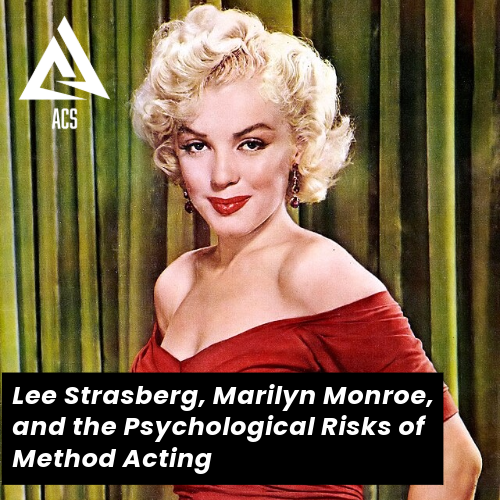
Marilyn Monroe (1926–1962) was already a serious Hollywood star when she determined to check underneath Lee Strasberg within the mid-Nineteen Fifties. Intrigued by the potential so as to add depth and realism to her performances, Monroe joined the Actors Studio in 1955 (Spoto, 2001). Beneath Strasberg’s steering, she devoted herself to refining her craft, hoping to transcend the “dumb blonde” stereotype and be taken significantly as a dramatic actress.
The Emotional Toll on Monroe
Folks near Monroe have famous that she was extremely delicate and struggled with power insecurity, nervousness, and melancholy (Spoto, 2001). By immersing herself in Strasberg’s emotionally charged workouts, Monroe generally reactivated painful private recollections. Whereas the Technique might have helped her obtain higher nuance in movies similar to Bus Cease (1956) and The Prince and the Showgirl (1957), it could even have heightened her psychological well being points, together with her use of medicine to deal with stress and insomnia (Monroe & Hecht, 2007).
Anna Strasberg, Lee Strasberg’s widow, later highlighted Monroe’s dedication to the craft and her vulnerability. Regardless of Monroe’s willingness to confront her emotional challenges for the sake of genuine performing, she typically discovered it troublesome to keep up private stability (Spoto, 2001).
The Psychological Dangers of Technique Appearing
Emotional Recall and Vulnerability
A cornerstone of Strasberg’s Technique is “emotional recall” or “affective reminiscence.” Actors draw upon private, generally traumatic, recollections to duplicate the emotional expertise of a scene (Strasberg, 1987). Whereas this will produce highly effective performances, it could additionally result in re-traumatization if the unique recollections are related to unresolved emotional wounds (Blum, 1984).
Lack of Private Boundaries
Technique Appearing encourages deep immersion, and a few actors wrestle to “flip off” the character after rehearsals or filming (Adler, 1990). This will blur private boundaries and result in confusion, nervousness, and identity-related challenges.
Heightened Stress and Isolation
The extreme deal with authenticity can induce appreciable stress. Actors might withdraw from private relationships or each day routines to keep up their efficiency mindset (Blum, 1984). Extended isolation or insufficient self-care—similar to inadequate sleep, poor diet, or a scarcity of social assist—can contribute to psychological well being issues together with nervousness, melancholy, and substance abuse.
Potential for Manipulation and Exploitation
In sure performing environments, the search for excessive emotional authenticity can create room for manipulation by administrators or performing coaches. Whereas Strasberg and his successors have careworn the significance of a cautious strategy, some establishments and people might overlook the potential dangers to psychological well being within the title of inventive purity (Garfield, 1980).
Balancing Authenticity and Properly-Being
Emotional Security Measures
Fashionable performing lecturers more and more prioritize emotional security when instructing Technique methods. Frequent suggestions embody:
-
Structured Cool-Down Workouts: Methods that assist actors “come down” from intense emotional states after rehearsals or performances.
-
Mindfulness and Self-Care: Practices like meditation, journaling, and peer assist assist actors preserve psychological well being.
-
Skilled Remedy: Common periods with psychological well being professionals might help performers handle triggers that come up from digging into private recollections (Fraser, 2015).
Various Appearing Methods
Actors who discover the Technique too emotionally intense might discover different extremely regarded methods. Stella Adler—initially a part of the Group Theatre—criticized the heavy reliance on private emotional reminiscence in Strasberg’s strategy. She developed her personal technique emphasizing creativeness and exterior stimuli, moderately than the actor’s inner experiences (Adler, 1990).
Likewise, Sanford Meisner emphasised in-the-moment responsiveness, coaching actors to totally interact with their scene companions. Decreasing the deal with inner emotional excavation can mitigate the psychological well being toll (Adler, 1990; Garfield, 1980).
Conclusion
Lee Strasberg’s Technique Appearing modified efficiency artwork by providing a path to deeply genuine portrayals. Marilyn Monroe’s experiences with the Technique exemplify each the strategy’s transformative potential and its toll on emotional well-being. Though Monroe achieved exceptional depth in her performances, her struggles additionally spotlight the psychological vulnerabilities actors might face when relying closely on private emotional recall.
Right this moment, many performing establishments acknowledge the significance of psychological well being and encourage secure, sustainable approaches to the craft. By acknowledging the powers and perils of Technique Appearing, performers and educators can attempt for a steadiness that preserves each inventive excellence and emotional integrity.
References
-
Adler, S. (1990). The Strategy of Appearing. Bantam.
-
Blum, R. (1984). The Stanislavski system within the classroom. Journal of Aesthetic Schooling, 18(3), 41–48.
-
Fraser, B. (2015). Psychoanalysis for Actors. Routledge.
-
Garfield, D. (1980). A Participant’s Place: The Story of The Actors Studio. Macmillan.
-
Monroe, M., & Hecht, B. (2007). My Story. Taylor Commerce Publishing.
-
Spoto, D. (2001). Marilyn Monroe: The Biography. Cooper Sq. Press.
-
Stanislavski, Ok. (1936). An Actor Prepares. Bloomsbury Educational.
-
Strasberg, L. (1987). A Dream of Ardour: The Improvement of the Technique. Penguin.